

The IDF struck the Gaza Strip on Monday for a second consecutive day, even as U.S. officials signaled that the Trump administration is willing to give Prime Minister Benjamin Netanyahu political “room” to navigate Israel’s approaching election, provided Jerusalem does not resume targeted killings that could derail efforts to advance the next phase of the Gaza agreement.
Monday evening’s strike was the second Israeli attack in Gaza since the military halted targeted killings under instructions from the political leadership.
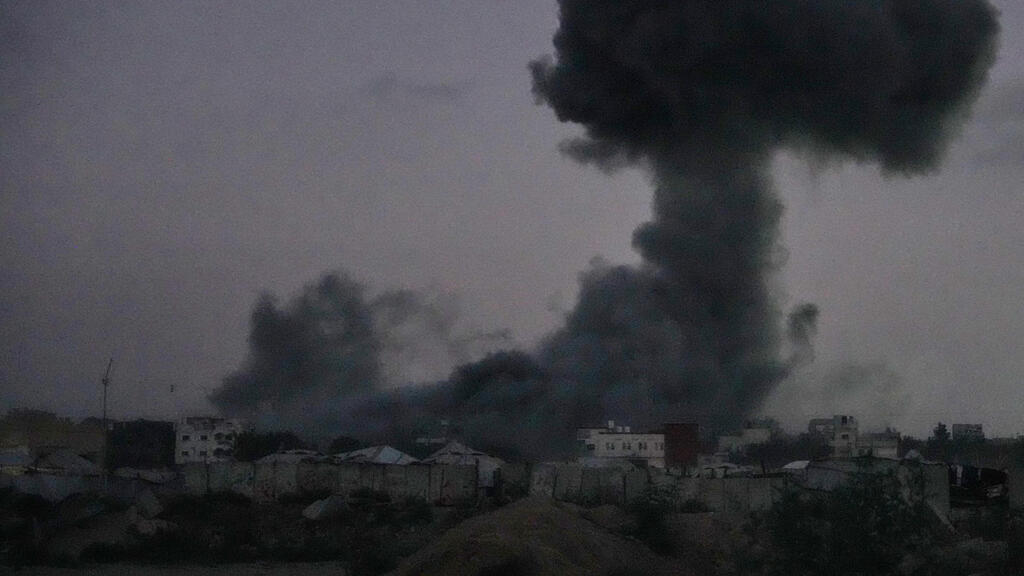
Unlike Sunday’s incident, in which troops opened fire on a Hamas sniper identified near the Yellow Line, Monday’s attack involved an Israeli Air Force strike in northern Gaza intended, according to the IDF, to “remove a threat.”
A security official said the strike did not require approval from the IDF chief of staff because Israeli troops faced an “immediate threat.”
Palestinian reports in Gaza described it as the first Israeli airstrike in more than a week and said one person was killed.
At the same time, Nikolay Mladenov, director-general of the Gaza Board of Peace and its official “high representative for Gaza,” announced that a new mechanism had begun operating to monitor violations of the agreement.
“In recent days, a mechanism for monitoring violations has begun operating,” Mladenov said. “Any confirmed violation will be addressed.”
He also rejected reports alleging that the Board of Peace had reached a financial arrangement with Hamas.
“The claims regarding a financial agreement between the Board of Peace and Hamas are false,” Mladenov said. “No such proposal was discussed, negotiated, considered or will be on the table in the future.”
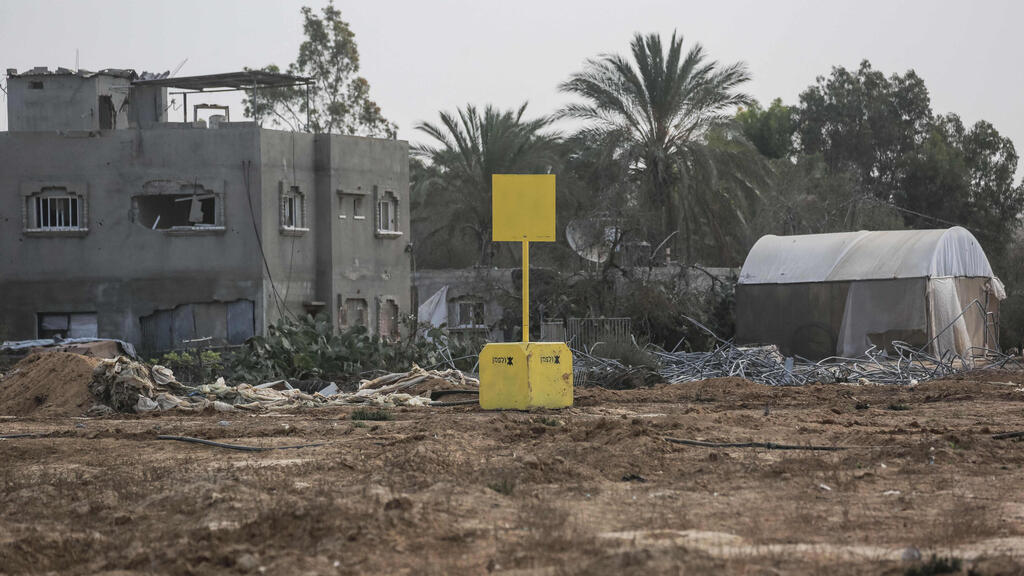
Concrete barrier marking the Yellow Line in central Gaza
(Photo: Bashar Taleb / AFP)
Mladenov noted that the Board of Peace was established under President Donald Trump’s Gaza plan and UN Security Council Resolution 2803.
“Both documents are public and clear: Hamas will have no role in governing Gaza and will have no access to funds,” he said.
He added that Board of Peace funds are not transferred through Hamas.
“Every contract undergoes checks and approvals, every job is verified before payment, and all accounts are open to full auditing by donor governments,” Mladenov said.
The international stabilization force, he added, is intended to support the disarmament process and the establishment of a civilian government in which Hamas has no role.
“That was our position from the beginning, and it has not changed,” he said.
Washington gives Netanyahu political room
U.S. officials, meanwhile, told Politico that the administration had initially been “disappointed” by Netanyahu’s rejection of the 15-point plan, which serves as the roadmap for implementing the Gaza agreement.
But officials said that disappointment eased after Washington concluded that Israel’s actions on the ground were largely consistent with the plan, despite Netanyahu’s public rhetoric.

Hamas conditions disarmament on an IDF withdrawal, while Israel demands the reverse order
(Photo: REUTERS/Ramadan Abed)
Israeli forces were instructed to obtain approval from the chief of staff before carrying out strikes, targeted killings were halted and troops remained positioned along the original Yellow Line.
One U.S. official said the administration is prepared to give Netanyahu “some room” to present the plan in a way that helps him politically.
“We recognize the complexities created by the elections in Israel, and we’re obviously going to give Bibi some room to try to navigate this,” the official said.
But that flexibility comes with an expectation from Washington.
“They need to give us a little room in terms of stopping the targeted killings to allow us to try to get to the next phase, so there are still a lot of challenges ahead,” the official said.
The administration understands that Netanyahu faces conflicting political pressures ahead of the election: pressure from his right-wing coalition partners on one side and pressure from Washington on the other, with unfavorable polling adding to the political difficulty.
The United States, through the Board of Peace and mediators Turkey, Qatar and Egypt, negotiated with Hamas over the roadmap, which in principle is intended to end with the terror group’s disarmament.
Under the framework, Hamas is supposed to surrender its weapons and transfer control of Gaza to a technocratic governing committee, while Israel is expected to withdraw its forces.
The first major obstacle emerged almost immediately.
Hamas has said publicly that it will not disarm until Israel withdraws from Gaza, while Israel insists that it will not withdraw until Hamas has disarmed.
Board of Peace director-general: 'Talks with Israel are continuing'
(Photo: AP Photo/Evan Vucci)
Despite Trump’s public confidence, including his declaration of a “historic agreement for the complete disarmament of Hamas,” administration officials had expected resistance from Israel.
Still, they believed negotiations could continue in practice.
“No one has ever gotten to the point where they brought Hamas to agree to this,” one U.S. official said, arguing that obtaining such an agreement was a necessary step before actual disarmament could take place.
Another administration official said the 27-member Board of Peace has recently received “good cooperation on the ground.”
“That’s what matters,” the official said.
Senior Board of Peace officials made a similar argument a day after Netanyahu rejected the roadmap, describing his opposition as largely declarative.
“We look at actions on the ground, less at words and declarations,” they said. “In practice, Israel stopped the targeted killings and is maintaining the ceasefire.”
They added that Israel was effectively implementing the 15-point agreement despite rejecting it publicly.
“The IDF is in practice standing on the original Yellow Line, 53% of the Strip, and there are no posts or forces beyond the Yellow Line. Israel is implementing the document, even if rhetorically it rejects it.”
‘The goal is to get through the election’
Dan Shapiro, who served as U.S. ambassador to Israel under the Obama administration, said Netanyahu’s political considerations are central to understanding the gap between his public position and Israel’s conduct.
“For Netanyahu, the main objective is obviously to get through the election,” Shapiro said.
“So he will at least voice rejection even while he may allow certain aspects to move forward.”
He added that Trump appears willing to tolerate that political balancing act.
“Trump seems to tolerate this dance by Netanyahu and is willing to tolerate the stated rejection,” Shapiro said.
Board of Peace officials stress that separate discussions with Israel are continuing and that the roadmap itself is an agreement between the Board of Peace and Hamas.
For now, however, Hamas’ stated willingness to disarm remains conditional on an Israeli withdrawal from Gaza, leaving significant doubts over whether the plan can ultimately be implemented.
Mladenov said Israel is not being asked to rely on trust or make irreversible concessions before concrete steps are verified on the ground.
“The objective remains complete disarmament and ensuring that Gaza never again poses the kind of threat Israel experienced on October 7,” he said.
He argued that the alternatives are either for Hamas to remain in power and rebuild its military capabilities, or for Israel to return to governing Gaza’s entire population at an enormous human, military and economic cost.
“The Board of Peace offers a third option: complete demilitarization, civilian government, an international security presence under American command and monitoring and verification mechanisms,” Mladenov said.
“There are more than enough real challenges in this effort. There is no need to invent additional ones.”