


While global headlines remain fixated on tactical surface skirmishes in the Strait of Hormuz, a far darker strategic transformation is unfolding in the shadows of international diplomacy. Deep within high-security shipyards, a covert technological arms race is quietly rewriting the fundamental rules of Middle Eastern survival.
On one side, Russian technical transfers are supercharging Iran’s advanced high-speed missile arsenal. On the other, Israel has deployed its most secretive naval asset to date: the INS Drakon. Following its public send-off and flag-raising ceremony in Kiel before transiting the canal toward Haifa, this custom-engineered submarine represents far more than a routine fleet upgrade. It is an extraordinary engineering response to an existential threat, built for an unforgiving era where early warning windows have collapsed from minutes to mere seconds.
Gallery

Iranian President Masoud Pezeshkian meets Russian President Vladimir Putin at the Shanghai Cooperation Organization summit in Kyrgyzstan
(Photo: Kristina Solovyova / POOL / AFP)
The strategic timing of the INS Drakon’s send-off highlights an expanding bilateral defense symbiosis built on shared security imperatives. At the farewell ceremony at the TKMS shipyard in Kiel, Israeli Ambassador to Germany Ron Prosor stood alongside German Naval Inspector Vice Admiral Jan Christian Kaack to mark the public departure of the third and final vessel of Israel's Dolphin-II AIP submarine series. At that exact moment, a German Navy frigate in the North Atlantic completed a classified test-firing of Israel’s LORA quasi-ballistic missile system, demonstrating precision strike capabilities reaching up to 500 kilometers according to German statements. This operational milestone illustrates a profound exchange: Germany adopts Israeli strike technology to reinforce NATO deterrence against Russian regional aggression across Europe, while Israel relies on premier German naval engineering to anchor its maritime security against an assertive Iranian axis.
According to intelligence documents regarding Project C430L, specialists from Russia’s NPO Mashinostroyenia have provided critical technical assistance to Iranian engineers. This technical cooperation focuses heavily on ramjet propulsion designed to power high-supersonic and low-hypersonic cruise missiles for land-attack roles. While Western defense officials note that Iran has not yet fielded fully operational supersonic cruise weapons in active service, Moscow's technical groundwork dramatically accelerates Tehran's offensive timeline. High-speed cruise missiles combine extreme velocity with low-altitude maneuverability, flying below traditional radar horizons and altering flight paths mid-course. When fully operational, these weapons compress command response times to razor-thin margins. A low-flying salvo launched from western Iran could target critical infrastructure in central Israel before early warning networks can process the vector.
For over two decades, Israel constructed the world’s most sophisticated multi-layered air defense architecture, relying on Iron Dome, David’s Sling, and Arrow systems engineered primarily to intercept incoming ballistic threats following predictable parabolic arcs. However, the rapid proliferation of ramjet-powered, high-speed cruise technology threatens to disrupt this traditional defensive geometry entirely. When coupled with advanced guidance systems, these low-flying maneuverable weapons bypass early warning boundaries and reduce critical decision-making timelines. In a volatile theater characterized by escalating nuclear ambiguity and shifting alliances, relying exclusively on land-based interception networks is no longer sufficient to guarantee national survival. Military planners must maintain an invulnerable strategic asset that survives any surprise opening salvo and guarantees a decisive, unlocatable counter-strike capability.
Enter the INS Drakon. Shipyard photographs reveal a striking structural evolution: a lengthened hull stretching roughly 73 to 74 meters, dominated by an unusually large, custom-designed sail tower. Prominent open-source naval defense analysts—including H.I. Sutton, Naval News, and The War Zone—assess this massive sail as most likely engineered to house vertical launch system (VLS) silos, enabling the vessel to carry far larger, longer-range standoff missiles than standard underwater torpedo tubes permit. While official authorities maintain strict secrecy regarding exact internal specifications, this design adaptation provides a stealthy platform for deep-sea deterrence. Though the submarine's initial redesign predates recent Project C430L leaks, the INS Drakon represents a long-term engineering solution that places an unlocatable counter-threat beneath Mediterranean waters, ensuring Israel retains a resilient retaliatory strategic veto.
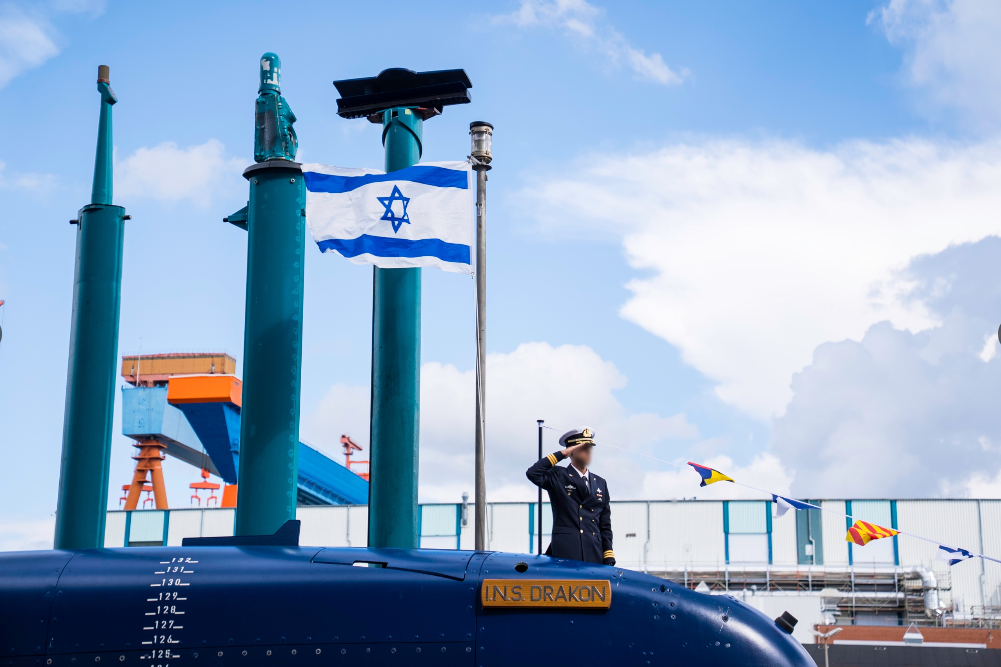
INS Drakon launch ceremony in Germany
(Photo: IDF)
The deployment of the INS Drakon signals a monumental paradigm shift in how strategic deterrence is executed within modern conflict zones. Public attention frequently fixates on high-visibility geopolitical skirmishes along critical trade routes like the Strait of Hormuz, yet the real structural power dynamics are shifting underwater. As covert technology transfers accelerate the proliferation of high-speed cruise missiles across the Middle East, traditional land-based defensive systems can no longer guarantee total security. The arrival of Israel's newest submarine in Haifa reflects a sober recognition that when warning windows collapse from minutes to seconds, a passive defensive posture alone is insufficient. True security demands an unlocatable, resilient platform capable of operating silently beneath the surface, effectively insulated from sudden land-based strikes.
Furthermore, the strategic deployment of the INS Drakon redefines Israel’s posture within the broader Eastern Mediterranean security framework. As offshore energy infrastructure like the Leviathan and Karish gas fields becomes increasingly critical to regional economies and European energy security, protecting these maritime assets against standoff missile strikes is paramount. By deploying advanced deterrence capabilities aboard air-independent propulsion submarines, Israel secures both its population centers and the economic lifelines that power its energy grid. The presence of the INS Drakon sends an unambiguous signal to regional adversaries: any attempt to target offshore infrastructure or critical navigation corridors will meet an immediate, devastating response launched from unmapped deep-sea coordinates far beneath the surface of the open ocean waters.
At the same time, the enduring defense collaboration between Germany and Israel proves that modern strategic survival is built on deep industrial integration. Despite ongoing diplomatic friction and political debates across European capitals regarding regional stability, the operational necessity of mutual defense keeps this procurement pipeline firmly open. Israel gains an invulnerable, state-of-the-art naval platform that preserves its second-strike nuclear deterrence under its long-standing policy of deliberate ambiguity, maintaining strategic leverage in an increasingly volatile region. In return, European armed forces acquire battle-tested missile technologies like the LORA system to fortify NATO borders against autocratic military expansion. This symbiotic relationship demonstrates how shared security threats drive deep technological collaboration, creating resilient defense networks that transcend fleeting political controversy and secure critical strategic interests for the long future.
Ultimately, the rise of Russian-assisted missile capabilities in Iran highlights a fundamental truth of twenty-first-century warfare: technology transfers have drastically compressed the space between peace and decisive conflict. When threshold states acquire supersonic ramjet engines and maneuverable low-altitude guidance systems, the traditional buffer of geopolitical warning disappears. In this dangerous environment, national survival depends on anticipating threat trajectories years before they manifest on the battlefield. The INS Drakon stands as proof that foresight, rather than reactive response, is the ultimate currency of military power. By developing a lengthened hull with vertical launch capability long before high-speed cruise proliferation made front-page news, Israeli defense planners ensured that their deterrence remained unbreakable against any future aggression originating from hostile regional adversaries everywhere.
 Amine Ayoub
As the INS Drakon completes its journey through international waters toward Haifa, it carries far more than sophisticated radar and advanced torpedoes; it carries the strategic balance of an entire region. Surface headlines will continue to chronicle tactical clashes and diplomatic spats, but the true calculus of deterrence will take place silently in deep ocean waters. In an era increasingly defined by high-speed weapons proliferation, compressed warning windows, and persistent regional ambiguity, strategic survival will not belong to those with the loudest public threats or the largest surface fleets. Instead, long-term survival is increasingly shaped by those who command the ocean depths, quietly maintaining an unlocatable counterweight that ensures no surprise attack can ever go unanswered from beneath the waves.
Amine Ayoub, a fellow at the Middle East Forum, is a policy analyst and writer based in Morocco. Follow him on X: @amineayoubx