

Voter turnout in Israel's parliamentary election reached 16.68% by 10 a.m. Tuesday, the highest level recorded at that hour since 1981, according to figures released by the Central Elections Committee. The early numbers suggest strong voter participation in an election that could determine Prime Minister Benjamin Netanyahu's political future.
More than 1.2 million Israelis had cast their ballots by 10 a.m., an increase of 0.78 percentage points compared with the same stage of the previous election. Acting Central Elections Committee Director-General Dean Livne announced the figures at the committee's control center in the Knesset, confirming that all polling stations across the country were operating.
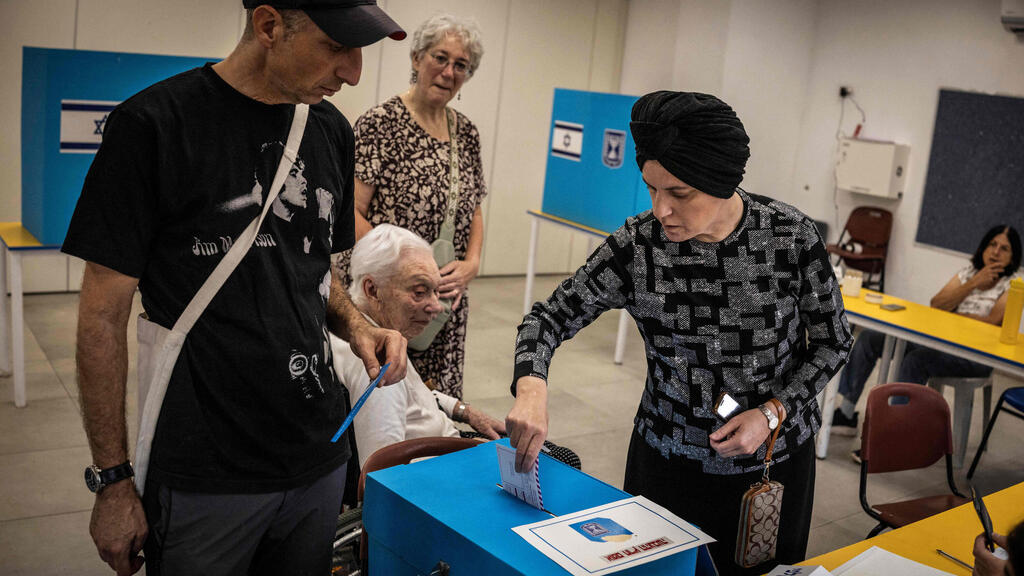
Voters in Jerusalem
(Phoot: JOHN WESSELS / AFP)
A total of 7,331,981 Israelis are eligible to vote in the election for the 26th Knesset, with 36 parties competing for seats in the 120-member parliament. Some 12,018 polling stations were scheduled to operate nationwide, with most opening at 7 a.m. and remaining open until 10 p.m.
Early reports indicated considerable voter interest, with long lines forming at polling stations in Ra'anana, Ramat Gan and other cities. At a school in Ra'anana, one voter expressed surprise at the unusually large morning crowds, saying she had never encountered such a long line so early on election day.
President Isaac Herzog, who voted in Jerusalem alongside his wife Michal, urged Israelis to exercise their democratic rights. He described election day as a celebration of democracy and called on citizens not to allow political divisions to undermine the process.
"This is our day to go out, make a difference and vote," Herzog said, emphasizing that all citizens have an equal voice at the ballot box. He also thanked the Central Elections Committee for its preparations and expressed hope that the election would proceed peacefully.
Central Elections Committee Chairman Justice Noam Sohlberg acknowledged the deep divisions within Israeli society but said elections remained the best available mechanism for resolving political disagreements. He stressed that every citizen was entitled to express their views freely through the democratic process.
Voting is taking place under unsettled weather conditions. The Israel Meteorological Service issued a yellow warning for thunderstorms and lightning between 10 a.m. and 2 p.m., with rain, strong winds and possible hail forecast across parts of the country. Flash floods are also possible in southern Israel.
The Central Elections Committee separately addressed online allegations that party representatives were using an application to monitor voters at polling stations. It said it had received no reports confirming such activity and reiterated that representatives are prohibited from transmitting information about individual voters' participation to political parties.
Although most polling stations will close at 10 p.m., when television networks release their exit polls, the final outcome may remain uncertain for several days. Between 600,000 and 650,000 Israelis are expected to cast special double-envelope ballots, primarily soldiers, reservists and displaced residents voting away from their registered polling stations.
Those ballots, representing roughly 15 parliamentary seats, will be counted separately and could significantly alter the distribution of seats, particularly for smaller parties close to the electoral threshold. Election officials expect to complete the full count by Thursday afternoon, meaning the identity of Israel's next governing coalition may remain unresolved well beyond election night.