

A man with a hooked nose lounging in a pool of money. A figure whose head is painted in the colors of the Palestinian flag, whose body is wrapped in an Israeli flag and whose neck is bound with a rope. These were not posters at a pro-Palestinian demonstration, but two cartoons shown to dental students at one of Canada’s leading universities. The person who displayed them was the faculty’s dean, Prof. Anil Kishen, an internationally renowned dental researcher.
Now, more than eight months after the slides triggered an uproar, the University of Toronto has announced that Kishen has stepped down as dean following an external investigation that concluded he had used antisemitic imagery, even though he did not intend to promote antisemitism.
Gallery
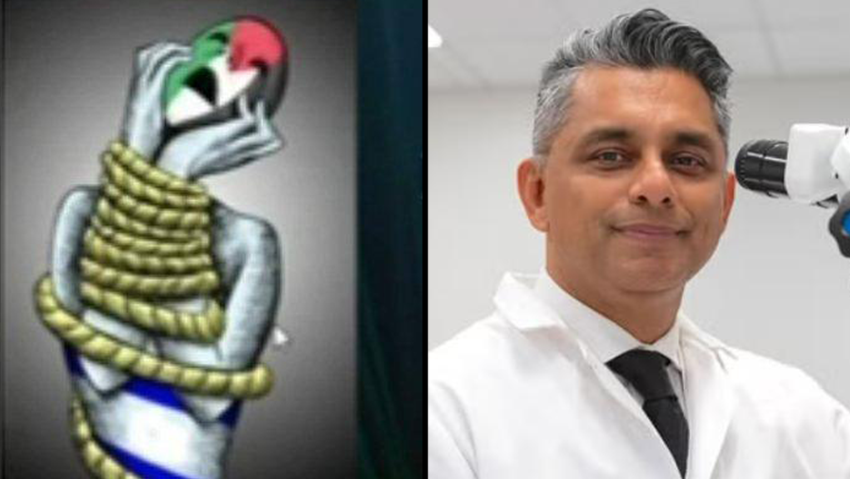
Prof. Anil Kishen stepped down as dean of the University of Toronto’s Faculty of Dentistry after controversy over antisemitic cartoons used in a lecture
(Photo: University of Toronto)
In a message sent Thursday to members of the Faculty of Dentistry, University Vice-President and Provost Prof. Trevor Young said the investigation found that Kishen had “limited knowledge about antisemitic imagery and tropes associated with Jewish people” when he included the images in his lecture materials.
That finding was not enough to save his position. Young said Kishen recognized that many members of the faculty had lost confidence in his ability to continue leading it, and the university reached an agreement with him to step down.
The controversy erupted in February after Kishen delivered a lecture to second-year dentistry students. One slide addressed a medical concept known as “strangulation theory,” describing how inflammation of the dental pulp, the tissue inside a tooth containing blood vessels and nerves, can disrupt its blood supply.
But instead of using a medical illustration of a tooth or blood vessel, the dean illustrated the concept with a figure wrapped in an Israeli flag, a rope around its neck and its head painted in the colors of the Palestinian flag. The Star of David had been removed from the Israeli flag in the image.
Another slide, intended to illustrate a concept related to the immune system, showed a man with a hooked nose relaxing in a pool filled with money, with the word “IMMUNITY” written on the side. Around the pool were figures with disabilities and injuries, including a person in a wheelchair and another wearing an eye patch. Complainants said the combination of an exaggerated nose and money echoed historical antisemitic caricatures depicting Jews as greedy and excessively powerful financially.
‘The power imbalance is enormous’
The affair came to light after a second-year dentistry student contacted the Jewish Medical Association of Ontario. The student said he was stunned to see what he understood as a caricature of a Jew with an exaggerated nose surrounded by money and was troubled that the image had been shown by the dean himself. He said the incident left him wondering how Kishen viewed Jewish students in his faculty.
The association forwarded the complaint to university administrators, and Kishen went on leave while the investigation was conducted. The images were removed from the course materials, and he apologized to students and faculty members.
“I selected these images as visual analogies for two concepts,” Kishen wrote. “I was not trying to make any political statements with these images. I say this not as an excuse for this mistake. I recognize that this has caused a great deal of harm, and I am deeply sorry.” He also pledged to improve his understanding of antisemitism and other forms of discrimination.

One slide showed a caricature of a man with a hooked nose relaxing in a pool filled with money
But the incident may not have been a one-time lapse. Dr. Lisa Salamon, president of the Jewish Medical Association of Ontario, reviewed materials from Kishen’s previous lectures and said at least one of the images had appeared in course materials in 2025. One slide deck she examined carried a 2022 date mark, she said, while a dentist told her he remembered the image from his own time as a student.
“This lecture had been occurring for many years,” Salamon said.
She also said students had previously complained about other incidents of antisemitism in the dental school without seeing their concerns adequately addressed.
“There have been a lot of other antisemitic incidents that happened within the dental school over the last few years, and every time they brought it forward, it went nowhere,” Salamon said. “Sometimes they were told they were unprofessional. They were totally ignored. They weren’t handled well.”
Prof. Pekka Sinervo, a former dean of the University of Toronto’s Faculty of Arts and Science and a co-spokesperson for the Association of Jewish Faculty and Staff, said Kishen’s senior position made the incident particularly serious.
“It’s one thing for one of our professorial colleagues to just say something stupid on social media, but it’s quite another when you have someone who actually has significant responsibilities, in this case for an entire faculty,” Sinervo said.
He said students can be reluctant to complain about instructors who may influence their academic and professional futures, particularly because the university’s complaint process is not anonymous. “The power imbalance is enormous,” he said.
The controversy was especially significant because of Kishen’s stature. He joined the University of Toronto in 2009 and is regarded as a prominent researcher in endodontics, the branch of dentistry dealing with areas including root canal treatment and diseases of the dental pulp. He has published more than 250 scientific papers, co-invented 12 patents and received major professional awards.
His appointment to a five-year term as dean was announced in April 2025, and he took office that July. His tenure as dean has now ended after just one year and four months.
A sanction, not a dismissal
The controversy had already reached the university’s governing bodies in March, when administrators were asked why Kishen had not been immediately dismissed. Young said at the time that the seriousness of the incident required a thorough investigation and a fair process.
In his latest announcement, Young said the investigation revealed deep divisions within the faculty. “Some community members accepted Dr. Kishen’s immediate apology, while others were deeply hurt by the use of the images,” he wrote.
The university has treated Kishen’s departure as dean as a sanction, but he will not be removed from the institution. He will remain a tenured professor after undergoing training on antisemitism and is expected to return to teaching and research during the 2027-28 academic year.
That falls short of demands from Jewish organizations that he be dismissed. B’nai Brith Canada said it would not allow “tenure and academic freedom to excuse and justify this egregious abuse of authority.”

Kishen will remain a tenured professor after undergoing antisemitism training and is expected to return to teaching and research in the 2027-28 academic year
(Photo: University of Toronto)
The affair comes amid growing reports of antisemitism in Canada’s health care system, particularly at institutions responsible for training doctors. In November 2025, the Jewish Medical Association of Ontario submitted a brief to the Canadian Senate’s Standing Committee on Human Rights containing data from a 2024 survey of nearly 1,000 Jewish physicians across the country.
According to figures presented by the association, 73% of respondents in Ontario reported exposure to antisemitism in academic settings and 64% reported such incidents in hospitals. Among Jewish medical students and residents in Ontario, the proportion reporting exposure to antisemitism in academic environments rose from 27% before the Oct. 7 attack to 63% in the following year.
Another figure presented to the Senate concerned the relationship between doctors and patients: 58% of the Jewish physicians surveyed said they were concerned that antisemitic bias among colleagues could harm Jewish patients or lead to substandard care.
The association called for independent complaint mechanisms protecting students and residents from retaliation, training for faculty members and medical administrators in recognizing antisemitism, and requirements for hospitals and universities to report transparently on complaints and how they were handled.
The figures also showed practical consequences: 14% of Jewish doctors surveyed said they had reduced their teaching activities because of experiences of antisemitism, while 31% said they were considering leaving Canada.