


The stream of commentary accompanying each round of fighting between the United States and Iran has produced a familiar collection of narratives.
Among them: President Donald Trump is under pressure because the U.S. economy is in crisis, perhaps even a severe one. Oil prices have surged following the closure of the Strait of Hormuz and now threaten global stability. Iran under the ayatollahs has far greater economic and social staying power than the United States, while the American public is supposedly united against the war.
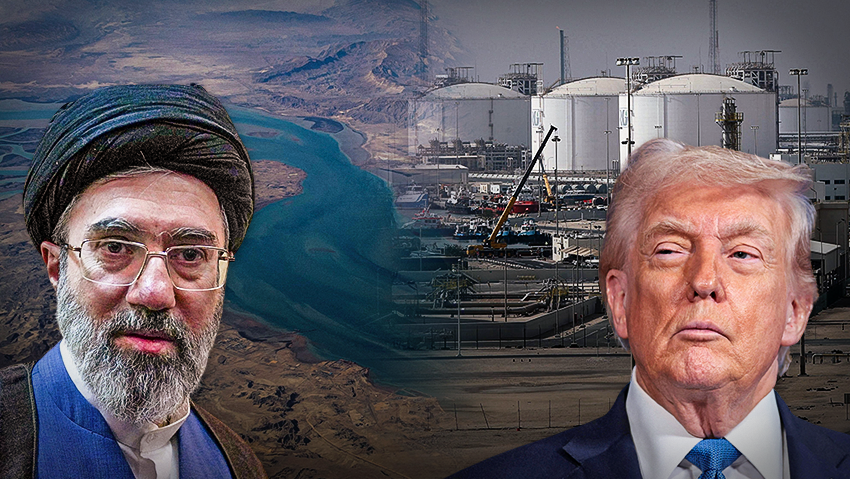
(Photo: Hamed Jafarnejad/ISNA/WANA (West Asia News Agency) via REUTERS, REUTERS/Jonathan Ernst, REUTERS/Stringer, AFP)
How much of this is supported by the facts? Very little, if any. The U.S. economy is neither in crisis nor close to one. It continues to grow at a reasonable pace, with full employment and rising inflation-adjusted wages despite a brief uptick in consumer prices.
In macroeconomic terms, the war has so far cost between 0.2% and 0.3% of the United States’ $32 trillion annual GDP, a negligible burden on the U.S. economy. U.S. military aid to Israel, meanwhile, amounts to just 0.01% of American GDP, well below the margin of statistical error.
The price of a barrel of oil is also nowhere close to creating global economic chaos. Historical comparisons are misleading. The world’s productive economy is far less dependent on oil than it was in 1974 or 1989, while the real price of a barrel remains tens of percentage points below the peaks reached in those years.
Only 2% of the world’s electricity is now generated from oil, and fluctuations in its price affect almost exclusively the cost of gasoline and diesel at the pump. The United States itself has transformed from an energy importer into a major energy exporter, and its oil and gas sector is earning enormous profits from higher prices.
Tensions surrounding the Strait of Hormuz will not collapse global markets. Today, even the smallest adjustment to artificial intelligence forecasts has a greater effect on stock exchanges around the world than the opening or closing of the strait. Alternative trade routes have already been found for oil, natural gas and rare minerals.
A prolonged closure would ultimately make the strait unnecessary, to Tehran’s detriment. At the same time, Trump has finally begun moving vigorously to establish a multinational fleet that would guarantee freedom of navigation throughout the waters of the Arabian Gulf. The U.S. military estimates that between 80% and 90% of Iran’s military capabilities in the area of the strait have been destroyed.
Iran cannot survive more than several additional weeks of fighting. The damage to its economy has already reached $200 billion, at least half of its annual GDP. Outside the wealthy neighborhoods on Tehran’s outskirts, the Islamic Republic is rapidly collapsing. Even subsidized basic goods are rising in price at an annual rate of 180%, with no compensation and no corresponding wage increases.
The war with Iran remains unpopular in the United States because it is widely seen as Trump’s war, at a time when the president’s approval ratings remain persistently low. In closed briefings, Trump and his closest advisers argue that the criticism is detached from reality. Iran’s leaders, they say, are the ones trapped in illusion: their military has been defeated and largely dismantled, their economy is on its knees and their society is beginning to fracture, yet they continue to portray themselves as the victors.
Those illusions, they argue, will eventually collapse. For an American superpower, the most effective strategy is a controlled war of attrition combined with diplomatic patience. Strength, Trump’s advisers add, lies not only in force, but also in restraint.
Trump has embraced that strategy and appears willing to wait until Tehran’s rulers abandon their illusions and acknowledge defeat. He favors a diplomatic victory over a battlefield one, but only if Iranian negotiators deal in good faith. Should they try to mislead him, his patience may run out quickly.