

As Tehran awaits a decision by the regime’s top leadership on an agreement that could allow the Strait of Hormuz to reopen, significant political developments in recent days point to intensifying power struggles within Iran’s new leadership.
The first concerns a wave of rumors that President Masoud Pezeshkian intends to resign. The president was forced to publicly deny the reports, saying in a televised interview that he had no intention of stepping down and that if he ever decided to do so, he would announce it officially. He also stressed that his government was fully coordinated with the armed forces and claimed that various parties were trying to create a false impression of a rift between him and Supreme Leader Mojtaba Khamenei.
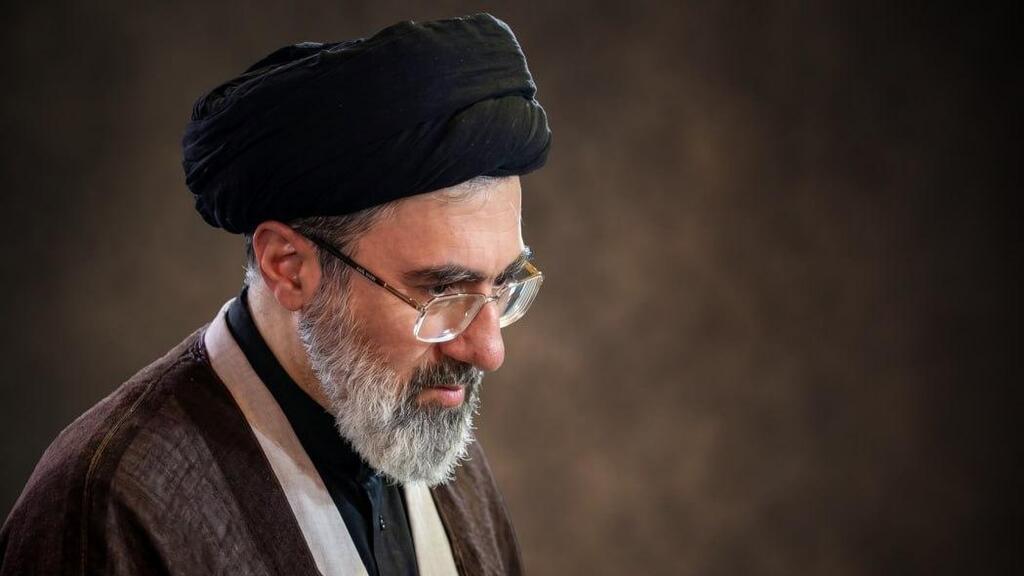
Mojtaba Khamenei
The supreme leader’s office also issued an unusual denial following claims by radical cleric Mohammad-Bagher Kharrazi that Pezeshkian had threatened to resign dozens of times and that Khamenei had said he would accept his resignation the next time. On Aug. 9, the supreme leader’s office reported that Mojtaba Khamenei had met with the president to discuss economic and security issues.
Kharrazi’s remarks were at the center of another political storm. The extremist cleric, who has family ties to the Khamenei family but holds no official position in the establishment, called in videos posted on social media for a mass mobilization of supporters to “take over” Tehran, the execution of women who do not comply with mandatory veiling and even the overthrow of the government.
His remarks prompted fierce reactions and led to his summons before the Special Court for the Clergy. Supporters of the president warned that his statements reflected an effort by the radical camp to undermine Pezeshkian, deepen internal polarization and seize control of political institutions.
In another significant development, Iran’s supreme leader announced the appointment of Mohsen Rezaei, a former commander of the Islamic Revolutionary Guard Corps and his military adviser, as his representative on the Supreme National Security Council. Shortly afterward, the president announced Rezaei’s appointment as secretary of the council, replacing Mohammad-Bagher Zolghadr, who was appointed to the post in April 2026 following the assassination of Ali Larijani.
The appointment came after reports that Pezeshkian had refused to accept Zolghadr’s resignation and opposed Rezaei’s appointment.
The question is whether the regime, already contending with serious domestic challenges, foremost among them a worsening economic crisis, will be able to contain the growing power struggles and move toward political stability, or whether they will deepen into a crisis that threatens its very survival
It is too early to assess the impact of the appointment. Rezaei, 71, who holds a doctorate in economics and served as commander of the Revolutionary Guards from 1981 to 1997, is known for his hard-line views and has been suspected of involvement in the 1994 bombing of the Jewish community center in Buenos Aires.
One of his sons, who emigrated to the United States, criticized the Iranian government’s policies and accused his father of supporting terrorist activities. In 2011, the son was found dead in a Dubai hotel. Some alleged that his father had a hand in his death.
Power struggles in the 'Third Islamic Republic'
After Iran and the United States signed a memorandum of understanding, Rezaei expressed reservations about the diplomatic moves led by Pezeshkian and parliament speaker Mohammad-Bagher Ghalibaf, calling instead for a tougher approach toward Washington.
Unlike Zolghadr, Rezaei appears to enjoy an extensive network of contacts and influence both in the supreme leader’s office and within the Revolutionary Guards. His appointment could therefore strengthen the position of the security and military camp in the upper echelons of the regime, led by IRGC commander Ahmad Vahidi.
This camp generally takes a hawkish approach and opposes concessions to U.S. demands. At the same time, Rezaei is also an experienced, power-seeking and opportunistic politician who has previously failed in attempts to be elected president of Iran and could adopt a more pragmatic approach if it serves his interests.
The latest developments provide further evidence of the power struggles within the “Third Islamic Republic,” which emerged after the assassination of Ali Khamenei and is still in the early stages of taking shape.
These struggles do not merely reflect disagreements between “pragmatists” and “radicals” or between the political leadership and the military-security establishment. Iran’s political system consists of numerous centers of power, and the Revolutionary Guards themselves are far from monolithic.
Sharp disputes also emerged at the top of the regime during the elder Khamenei’s rule, but he was capable of serving as the final arbiter and decision-maker. That stands in contrast to his son, who has yet to consolidate his rule, in part because of his prolonged absence and security and health circumstances that have complicated effective decision-making.
 Raz Zimmt
 As Iran moves further away from the phase of active fighting, senior officials at the top of the regime appear to be stepping up efforts to exploit the situation to consolidate their positions within the new leadership.
The outcome of these struggles will affect not only the future of negotiations with the United States and the choice between a diplomatic settlement and economic development on one hand and the continued doctrine of “resistance” and prolonged warfare on the other. It will also shape the future character of the Islamic Republic, including the possibility of a transition from theocratic rule to an authoritarian military model led by the Revolutionary Guards.
A central question is whether the regime, already contending with serious domestic challenges, foremost among them a worsening economic crisis, will be able to contain the growing power struggles and move toward political stability, or whether they will deepen into a crisis that threatens its very survival.
- Dr. Raz Zimmt is director of the Iran and Shiite Axis Program at the Institute for National Security Studies (INSS).
First published: 15:11, 08.10.26