


When Pakistan declared that an attack on Saudi Arabia would be treated as an attack on Pakistan, it sent a powerful strategic message. Alliances derive their value not from the ink on treaties, but from the credibility of commitments. Deterrence works only when adversaries believe promises will be kept. Today, that credibility is being tested.
Pakistan’s hesitation is understandable. Iran is a neighbor with whom it shares a long border. Pakistan faces internal security challenges, sectarian sensitivities, economic constraints and an enduring rivalry with India. Entering a direct conflict with Iran would carry significant costs.
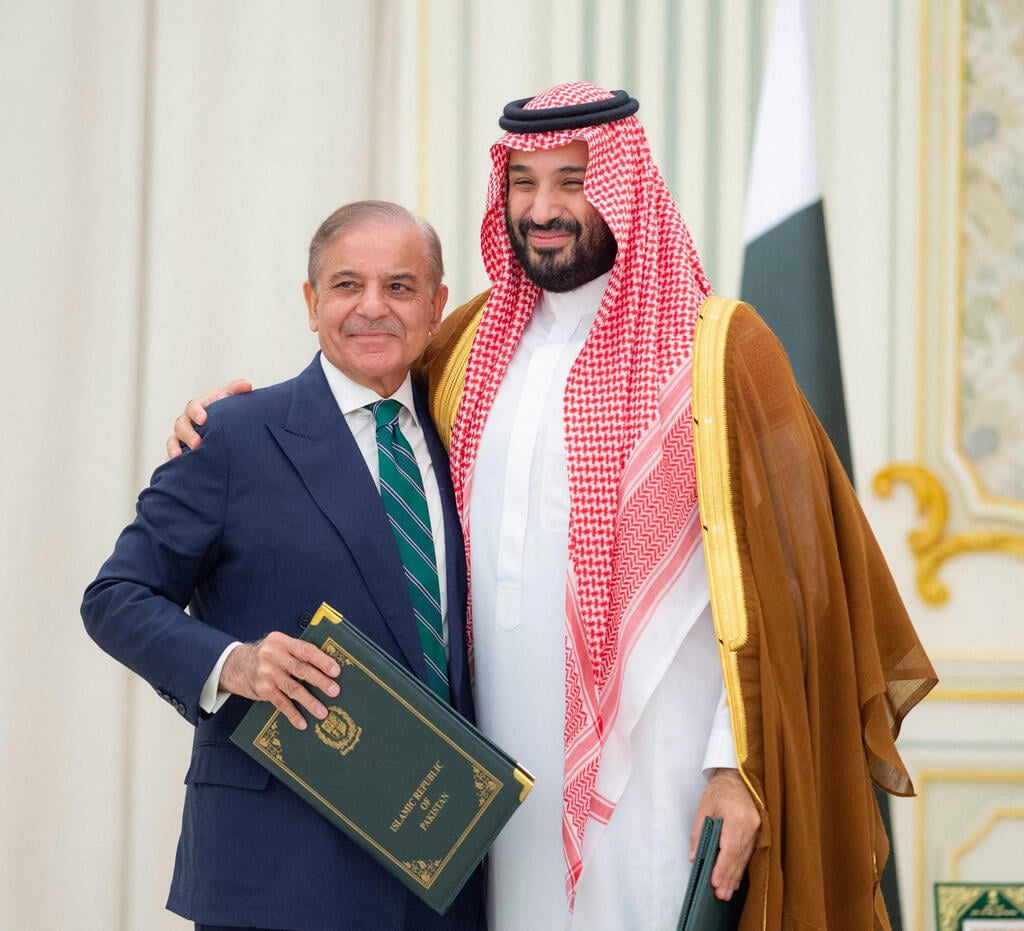
Pakistani Prime Minister Shehbaz Sharif and Saudi Crown Prince Mohammed bin Salman
(Photo: Saudi Press Agency/Handout via REUTERS)
Yet alliances are meaningful precisely because they require states to bear costs in defense of partners. If commitments are honored only when convenient, they cease to be commitments and become political slogans.
The contrast with Pakistan’s response to India is striking. When India attacked Pakistani territory, Islamabad reacted immediately. There was no prolonged debate over strategic ambiguity or legal interpretation. Pakistan correctly viewed deterrence as requiring a swift response. That same logic applies to alliances. If Pakistan expects its own red lines to be respected, it must demonstrate that Saudi Arabia’s red lines are equally credible.
This does not mean Pakistan should seek war with Iran. Responsible statecraft requires restraint and proportionality. A credible response can take many forms: integrated air defense, intelligence cooperation, military deployments, maritime security, economic measures or, if necessary, calibrated military action. The essential point is not the form of the response, but the unmistakable demonstration that treaty obligations have consequences.
The broader issue extends beyond the Middle East. Around the world, alliances are increasingly being scrutinized. Whether in Europe, Asia or the Gulf, adversaries are asking the same question: will allies actually show up when it matters?
 Prof. Ilan Alon Photo: Courtesy
Credibility is cumulative. It is built over decades but can be undermined in a single moment of hesitation.
Pakistan has long sought to position itself as a pivotal regional power and a reliable security partner for the Islamic world. That ambition carries responsibilities as well as benefits. If Islamabad wishes to maintain its strategic influence, it must ensure that its security guarantees are perceived as more than diplomatic rhetoric.
History teaches that deterrence depends less on military capability than on political resolve. States rarely challenge commitments they believe will be honored. They frequently test those they suspect will not.
Pakistan’s response in this moment will therefore resonate far beyond its relationship with Saudi Arabia. It will shape how allies, rivals and investors assess the country’s reliability for years to come.
In international politics, credibility is a nation’s most valuable strategic asset. Once questioned, it is remarkably difficult to restore.
- Professor Ilan Alon is a professor of Economics and Business at Ariel University (Israel) and the University of Agder (Norway)